
Review · COMMUNIST ERA AND COLD WAR TOURS
Communist Budapest Private Walking Tour
Communist sites in Budapest are still everywhere. This private 3-hour walk connects the city’s streets to the communist era, and I especially like the private historian guide and the focus on 1956 uprising locations that still feel raw. One thing to plan for: the tour keeps the museum time mostly outdoors, and major interior visits are not included.
You also get more than captions. Expect clear talk about everyday life under Hungary’s “goulash communism,” plus how propaganda shaped what you saw in public squares, on buildings, and along parade routes.
Logistics are pretty smooth. You can choose a morning or afternoon start, and pickup is offered so you are not left hunting meeting points, though you will still ride metro or tram for some stretches.
In This Review
- Quick hits before you go
- Why communist Budapest feels different on a guided walk
- Price and group size, is it worth it?
- Meeting, pickup, and getting around without stress
- Your historian guide: the difference between facts and meaning
- Stop-by-stop: Parliament to Cold War crossroads
- House of Terror: why ending outside still works
- Puskas Ferenc Stadium area: propaganda in plain sight
- The Reagan statue stop: Hungary’s complicated obligation to the Iron Curtain end
- Bem József Square and a 1960s coffeehouse detail
- The housing-estate era stop: from revolution to daily life under socialism
- What you learn about life in Hungary’s “goulash communism”
- How long it takes, and what to expect for timing
- Who this tour is best for
- Should you book this communist Budapest private walking tour?
- FAQ
- How long is the Communist Budapest Private Walking Tour?
- Is this tour private?
- What is included in the price?
- Are tickets to museums included?
- Do I need tram or metro tickets?
- Where does the tour start?
- Where does the tour end?
- Is pickup available?
- What group size should I expect?
- Is there a choice of departure time?
Quick hits before you go
- Historian-led, not lecture-by-phone: a local guide with historian training, built for storytelling on the sidewalk.
- 1956 and Cold War, linked together: you move from revolution sites toward post-1956 power and US-Soviet tension.
- A “read the city” approach: socialist-era statues, parade streets, and regime symbols become your guidebook.
- Housing-estate era snapshots: you see the planned look of later socialist life, not just dramatic political moments.
- House of Terror as a perfect follow-up: you end at the museum’s outside walls, ready if you want the interior afterward.
Why communist Budapest feels different on a guided walk
Budapest has an honest way of showing its layers. Even when the regime is gone, the city layout, the big official buildings, and the carved stone symbols stayed put. That makes a walking tour more than a history lesson. It becomes a way to see how power worked, where it gathered people, and what it tried to make normal.
The best part for me is the balance: you do not just get slogans or dates. You get context for why these places mattered, how the communist system communicated control, and what people quietly endured between the headline events. The historian style matters here, because the guide can connect the dots between the 1949 to 1989 era and what the streets still show today.
You also get to travel at a human pace. Three hours is long enough to cover real ground, but short enough that the day stays enjoyable. And because it is private, the tone stays focused on what you actually want to understand.
Price and group size, is it worth it?
The price is listed per group, at $393.17 per group (up to 10), and there is also a stated maximum of 8 travelers. In other words, your cost per person drops fast if you are traveling with friends or family.
Here is the practical way to think about it. If you are a solo traveler, a private historian tour is rarely the cheapest option in Budapest. If you want the “small group, high-context” experience and you care about interpretation rather than just seeing sights, it can still feel worth it because you are paying for time with an expert and a tight route plan.
If you are 2 to 6 people, it usually becomes a strong value. You get privacy, you get pacing that can be adjusted, and you avoid the frustration of matching a standard group itinerary when your interests are more political, more personal, or more architectural.
If you are eight people, you still keep the experience personal. And you are not stuck in a giant crowd while trying to understand symbols that are easy to miss at normal walking speed.
More of the socialist decades, told on foot
- Budapest: Communist History Tour with House of Terror Option
★ 4.8 · 182 reviews - Communism in Hungary with a Historian
★ 5.0 · 70 reviews - Budapest: 3-Hour Walking Tour About Communism (Small Group)
★ 4.7 · 70 reviews - Lives of Hungarians Under Communist and Capitalist system
★ 5.0 · 59 reviews
Meeting, pickup, and getting around without stress
You get the option of pickup from your central hotel or flat. The guide meets you and then leads your group by metro, tram, or foot, depending on how close the next sites are. If you do not have a transport pass, you get help with tickets. You will also receive a mobile ticket for the activity.
One small practical tip: have your start location sorted early. If you prefer not to do pickup, or if pickup details are delayed, plan to meet your guide 15 minutes before start time at the default meeting point. That buffer helps you start on time, which matters because the route depends on transit connections.
Also, do not underestimate how much time moves with public transport. This is not a “sit on a bench and read plaques” tour. You are in motion, and the guide uses that movement to tell the story properly.
Your historian guide: the difference between facts and meaning
The guide is a local historian and storyteller, not just a driver-with-a-voice. The reviews highlight this clearly, including praise for guide knowledge and clarity, plus humor and perspective.
I like that you can feel the guide’s flexibility. One review notes that Andras adjusted the tour to match the group’s interests. That is exactly what you want on a topic this heavy. Different people want different angles, whether it is revolution history, Cold War diplomacy, or what life looked like in everyday neighborhoods.
Another review credits Kata with clear explanations and a broader world view. That matters because communist regimes are not just about Budapest. They connect to wider European politics, and a good guide keeps those threads understandable without turning the tour into a timeline dump.
So yes, you will learn dates and names. But the bigger payoff is interpretation, how symbols and settings connect to human choices and limits.
Stop-by-stop: Parliament to Cold War crossroads
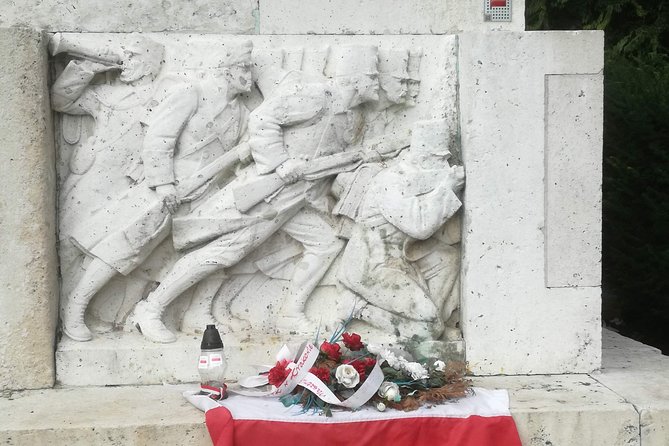
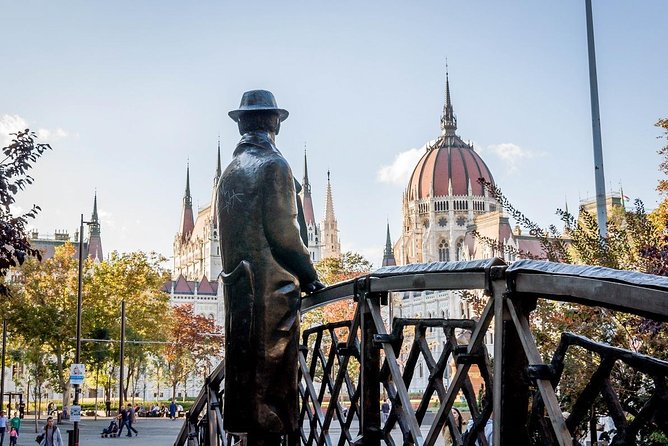
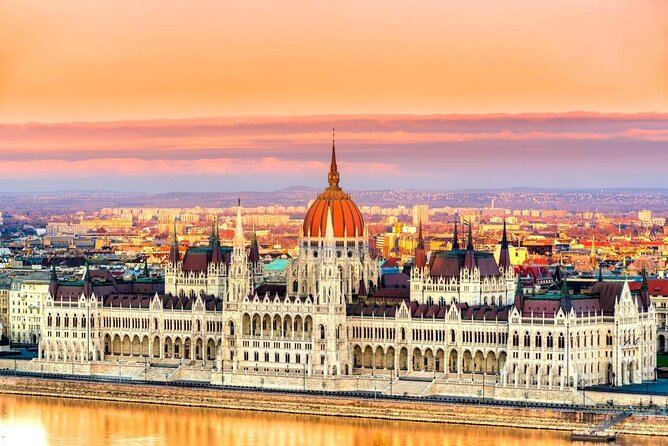
Your first walk segment sets the tone. You head to Kossuth Square in front of the Parliament Building, then explore revolution-era monuments before continuing toward Liberty Square. This part works because you begin with the architecture of authority and then layer in the struggle around it.
From there, you focus on Cold War elements you can only really appreciate in context. The route includes discussion around the US Embassy, the monument to the Soviet Army, and public-facing symbolic gestures tied to the tense US-Soviet standoff. You also see the Ronald Reagan statue and an atomic shelter reference as part of the story of fear, readiness, and messaging.
In practical terms, you are walking through squares that were designed to hold major gatherings and to project state power. If you have ever wondered why certain streets feel so monumental or why certain buildings get the most attention in photos, this is where you start understanding the “why.”
Time at this first cluster is about 25 minutes, with no admission required.
House of Terror: why ending outside still works
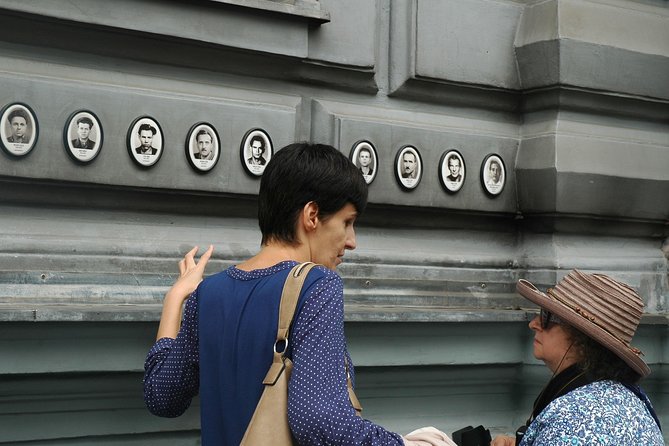
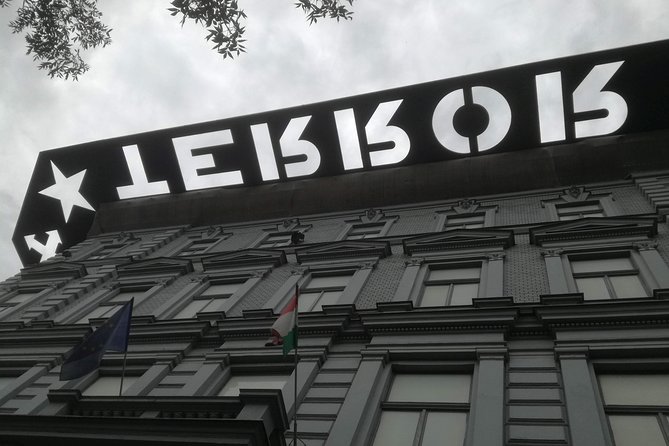
You finish the route’s core political sites by reaching the House of Terror Museum exterior. The museum sits in the former headquarters of Hungary’s communist secret services, and there is a Berlin Wall slab in front. Even without entering, the exterior hits hard because it is tied directly to the machinery of repression.
This stop is about 15 minutes, and admission is not included. The tour does not cover the interior exhibit, so if you want the full museum experience, plan to add it separately on your own.
That said, ending here is smart if you have curiosity but want control. You can decide whether to go inside right away, come back later, or simply use the exterior as a high-impact final note before you head for dinner.
If you are the type who likes to turn your “tour stops” into deeper research, this is a good endpoint. You have the context fresh in your head, and the museum door is right there.
Other Budapest walks at a similar pace
Puskas Ferenc Stadium area: propaganda in plain sight
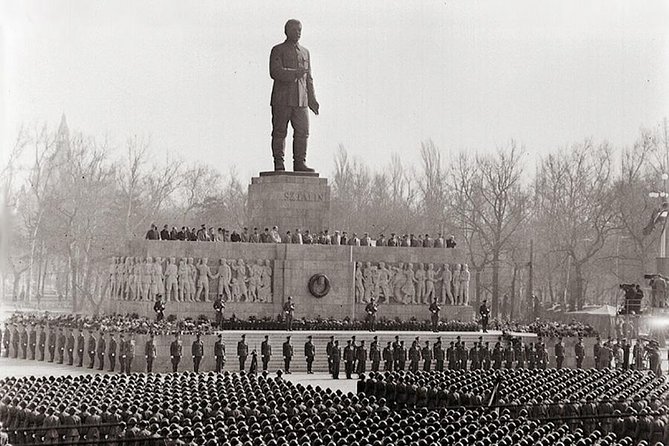
Next you pass by the former People’s Stadium, now known as Puskas Soccer Stadium. The theme here is how regimes used public space, and specifically how socialist realist design carried political intent.
The tour notes socialist realist statues still standing around this setting. That matters because it shows you how propaganda is not only in textbooks or official documents. It is built into the visual language of public places people use for everyday life, like sports and large gatherings.
Stop time is around 20 minutes, and admission is free for this exterior viewing segment.
One caution: stadium areas can feel more open and windy than you expect, depending on the season. Bring layers and plan your footwear accordingly. You will be walking, and comfort helps you stay focused on what the guide is pointing out.
The Reagan statue stop: Hungary’s complicated obligation to the Iron Curtain end
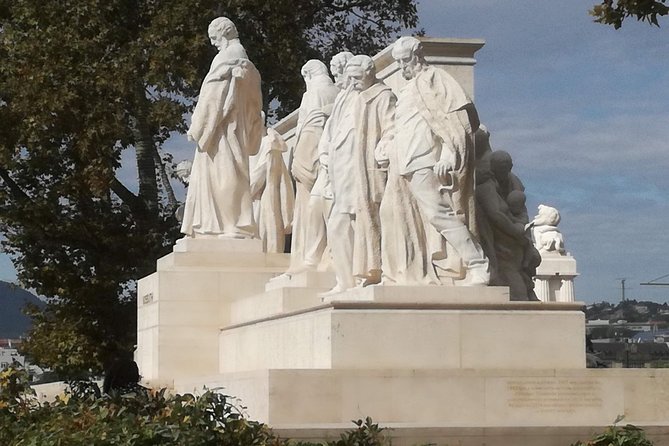
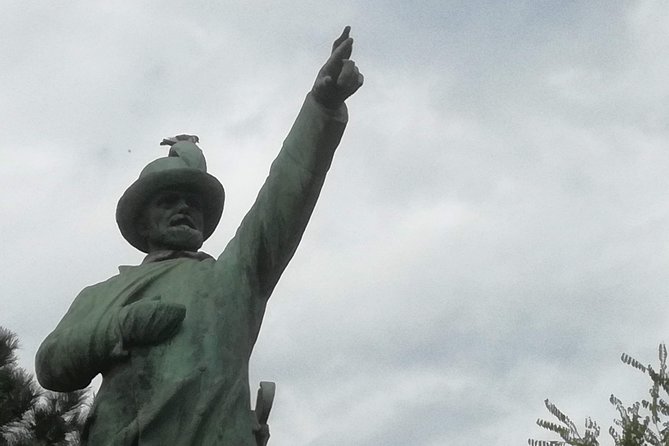
You then shift to a shorter but meaningful stop for the Ronald Reagan statue. The tour frames it through the Hungarian sense of obligation to him for efforts that helped bring down the Iron Curtain.
This moment is worth taking seriously. In most cities, a politician statue is just a photo background. Here, the guide’s context makes it a clue about postwar storytelling and how later interpretations of Cold War events found a place in public space.
Time is about 10 minutes, with no admission needed.
If your brain wants to connect the earlier Liberty Square Cold War discussion to a later symbol, this stop helps do it in a clean, focused way.
Bem József Square and a 1960s coffeehouse detail
The final main stop is Bem József Square, also known as Bem Square. This is tied to the 1956 uprising, because it was the site of the first big demonstration of the uprising.
That is the kind of detail that changes the way you walk the area. Instead of seeing an ordinary square with buildings around it, you see a place that hosted a turning point. The guide’s explanation makes the geography feel active, like the square was a stage for events rather than just a location on a map.
There is also a special cultural detail here: a coffeehouse on the square that has retained its original interior from the 1960s. That is not just a trivia win. It is a tangible way to sense what “everyday” looked like while politics and shortages shaped daily life.
This stop runs about 25 minutes and requires no admission for the tour component.
The housing-estate era stop: from revolution to daily life under socialism
Along the route, you also spend time at a 1970s housing estate. This part shifts the focus away from dramatic demonstrations and toward how the socialist system influenced everyday living.
Why it matters: revolutions grab attention, but most people live through policies day after day. Housing estates represent that slower kind of history, the kind where you feel the system every time you walk home, wait for services, and try to build a life within constraints.
So if you only care about headline events, you might wonder why this stop exists. If you want to understand the full era, it is one of the most useful parts, because it helps you connect politics to ordinary routines.
What you learn about life in Hungary’s “goulash communism”
The tour is built to explain the privations and compromises behind the phrase goulash communism. Even if you have read about communist economies, hearing the topic tied directly to visible city settings makes it easier to grasp.
You get a sense of how the system worked in practical terms: not as an abstract ideology, but as something that shaped what people could buy, how they planned, and how they lived with shortages or restrictions. Then you see how the state countered that reality with public messaging, monuments, and ceremonies.
This is where a historian guide earns their fee. You are not just looking at objects. You are learning how objects functioned in the era, and why they were placed where they were.
How long it takes, and what to expect for timing
Duration is listed at about 3 hours. One review mentions a four-hour private tour with Andras, adjusted to the group’s interests. That suggests the guide may expand or slow the story where it fits your questions and how much you want to linger at each stop.
Plan for the reality of a walking and transit route. Even with a compact schedule, you will spend time near each cluster for explanations. If you want extra time for photos or a quick snack stop, you can build it in after your tour ends at the House of Terror area.
Who this tour is best for
This experience fits best if you want more than a surface-level overview of communist Budapest.
You will likely love it if:
- you enjoy political history with clear local context
- you like tracing themes through architecture, statues, and public squares
- you want a guide who can answer questions without turning it into a rigid script
- you plan to follow up at the House of Terror on your own
You might be less happy if:
- you want a heavy museum interior itinerary (the tour notes that the exhibit is not included)
- you prefer long stops inside venues rather than exterior storytelling
- you want a purely scenic walk without political framing
Should you book this communist Budapest private walking tour?
I think it is a smart book for the right traveler. If communist-era Budapest is on your list, this route gives you a tight storyline from Parliament-area Cold War tension down to Bem Square and the 1956 uprising, then ends at the House of Terror exterior where you can choose your next step.
The biggest strength is the historian guide experience, the kind of clear explanation and adaptable pacing reflected in reviews naming Andras and Kata. The second strength is focus. You are not collecting random stops. You are seeing how power used space, monuments, and public events, then understanding why daily life under socialism felt the way it did.
If you are a solo budget traveler, consider whether a per-person tour makes sense for your travel style. If you are traveling with friends or family, the per-group pricing usually turns it into solid value for a high-context afternoon. And if you are especially curious about the secret service era, finishing at the House of Terror is an excellent way to keep the story alive without forcing you into museum hours.
FAQ
How long is the Communist Budapest Private Walking Tour?
The tour lasts about 3 hours.
Is this tour private?
Yes. It is a private guided walking tour with a historian guide.
What is included in the price?
Included is a 3-hour guided walk with a private historian guide.
Are tickets to museums included?
No. The House of Terror Museum exhibit is not included, so its admission is not part of the tour price.
Do I need tram or metro tickets?
Tram and metro tickets are not included. Your guide can assist you with purchasing the required tickets if you do not already have a transport pass.
Where does the tour start?
The tour start meeting point is in Budapest at Frankel Leó út 2-4, 1027 Hungary.
Where does the tour end?
The tour concludes outside the House of Terror Museum at Andrássy út 60, 1062 Hungary.
Is pickup available?
Pickup is offered from your central hotel or flat, and your guide will meet you there and lead your group to the sites.
What group size should I expect?
The experience has a maximum of 8 travelers.
Is there a choice of departure time?
Yes, you can choose either a morning or an afternoon departure.
More Tours in Budapest



More Tour Reviews in Budapest



More From the Socialist Years




Reviewed recently around Budapest
- Audio visual multi-sensory chefs journey dinner experience★ 5.0 · 3 reviews
- Tapolca Cave Lake and Tihany/ Balaton private tour from Budapest★ 4.5 · 3 reviews
- SzentEndre-SaintAndrew City Privately Shopping and Picturesque★ 4.5 · 3 reviews
- Sightseeing flight over Budapest★ 5.0 · 3 reviews
- Self Guided Tour In Budapest With 100 Captivating Audio Stories★ 5.0 · 3 reviews
- Private Danube Bend Visegrad and Szentendre Tour With Transport★ 5.0 · 3 reviews
Communist Era and Cold War Tours, compared.
 ★ 4.8Communist History Tour with House of Terror OptionFrom $58182 reviews
 ★ 5.0Communism in Hungary with a HistorianFrom $5970 reviews
 ★ 4.73-Hour Walking Tour About Communism (Small Group)From $5770 reviews
 ★ 4.5Budapest Hammer & Sickle Communist Times TourFrom $7968 reviews
 ★ 5.0Lives of Hungarians Under Communist and Capitalist systemFrom $459 reviews
 ★ 5.0Guided Tour with Admission in Memento ParkFrom $3048 reviews
 ★ 4.5Memento Park TicketFrom $1046 reviews
 ★ 5.0Memento Park Visit with Private Trabant TransferFrom $30544 reviews
Browse the lists this tour appears in