
Review · COMMUNIST ERA AND COLD WAR TOURS
Communist Budapest Walking Tour
Communism shows up in Budapest’s everyday streets. On this Communist Budapest Walking Tour, you follow the city’s shift from the 1956 uprising to the machinery of control, using real landmarks and a professor-level guide. It’s a guided timeline you can walk, stop, and picture.
I love how it starts at Bem József Square and makes the 1956 story feel immediate, including a coffeehouse interior kept from the 1960s. I also like the contrast from Freedom Square to the House of Terror, where monuments, propaganda, and repression sit within easy reach.
One thing to plan for: the route uses metro and a trolley bus, and tram and metro tickets are not included, so you’ll want transit payment sorted. If you already know modern Hungarian history deeply, you may find you need to ask more targeted questions to move past the essentials.
In This Review
- Key highlights you will care about
- Where the tour starts at Bambi Eszpresszó
- Bem József Square: the 1956 uprising begins where you can still feel it
- Kossuth Square and Parliament: monuments tied to armed conflict
- Freedom Square’s Cold War symbols, all in one walk
- 1970s housing estates: grey buildings with a real reason for hope
- Puskás Stadium and Socialist Realist statues you can see clearly
- Dozsa György Street: trolley buses, May Day parades, and staged spectacle
- The House of Terror: crimes of communism in a former secret services HQ
- Price, value, and how to judge $123 for 3 hours
- Who should book this tour, and who should think twice
- Final call: should you book Communist Budapest Walking Tour?
Key highlights you will care about
- A professor-grade guide: guides are professors, doctoral students, historians, journalists, art critics, and published authors.
- Bem József Square to Kossuth Square: you track the 1956 uprising using the places where major events unfolded.
- Freedom Square’s Cold War lineup: the U.S. embassy, Soviet army monument, a Ronald Reagan statue, and a secret atomic shelter entrance.
- 1970s housing estates on the edge of town: you see why young families celebrated apartments with elevators and modern conveniences.
- Social Realist art in the open: Socialist Realist workers, soldiers, and intellectuals still show up at Puskás Stadium.
- Contrast made visual: your guide uses an iPad and older photos to compare then and now.
Where the tour starts at Bambi Eszpresszó
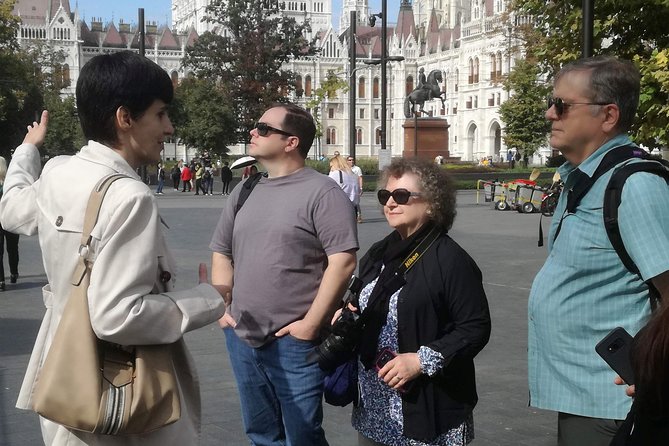
You meet at Bambi Eszpresszó at Frankel Leó út 2/4, 1027 Hungary. The easiest way to enjoy the first moments is to arrive a few minutes early and settle in. The setting matters here, because part of the experience is noticing how everyday spaces held on to older interiors even as politics changed around them.
This tour is built as a 3-hour walk with some short metro and trolley bus segments. That mix helps you cover key sites without turning it into a marathon, and it also gives you a moving “memory map” of central Budapest and its outer housing areas. English is the tour language, and you can expect private or small groups, which usually means you can ask questions without feeling rushed.
Bem József Square: the 1956 uprising begins where you can still feel it
The tour kicks off at Bem József Square, known for the first large demonstration during the 1956 uprising. What I like about this approach is that you get context before the big-name landmarks. Instead of treating 1956 as a headline, you start with a specific place and a specific moment.
From there you’ll also see a coffeehouse that kept its original interior from the 1960s. That’s not just a visual detail. It’s a reminder that Communist life was not only parades and monuments. It included normal routines, social spaces, and the stubborn continuity of everyday culture.
In a good guide-led format, this opening works because it frames what follows. By the time you reach Kossuth Square, you understand that the revolution was not a single event. It was a chain of responses, protests, and confrontations unfolding in real locations.
More of the socialist decades, told on foot
- Budapest: Communist History Tour with House of Terror Option
★ 4.8 · 182 reviews - Communism in Hungary with a Historian
★ 5.0 · 70 reviews - Budapest: 3-Hour Walking Tour About Communism (Small Group)
★ 4.7 · 70 reviews - Lives of Hungarians Under Communist and Capitalist system
★ 5.0 · 59 reviews
Kossuth Square and Parliament: monuments tied to armed conflict
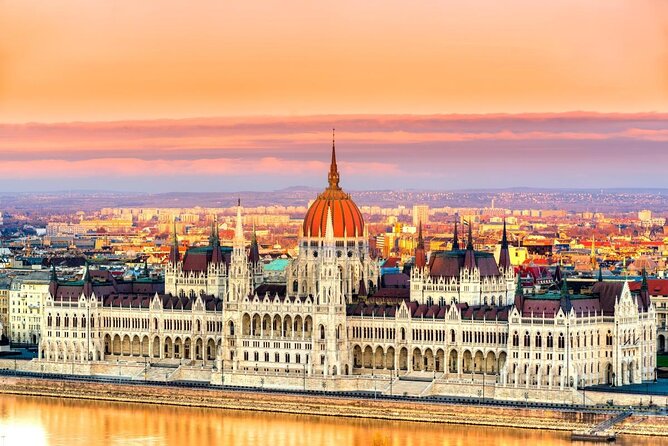
Next comes Kossuth Square, then the walk to the area in front of Parliament. Here the tour focuses on monuments that reflect the political and armed conflicts of the 1956 revolution. This is where the story shifts from “what happened” to “how Budapest remembers.”
Look closely at what’s emphasized and what’s placed where. Monuments are not neutral objects. They are choices about narrative, memory, and which side gets to be seen as legitimate. Seeing these pieces in person, with your guide’s explanation, helps you read the square like a historical document.
It also helps that you’re traveling with an academic profile. The guides are not just casual storytellers. They are professors, doctoral students, historians, journalists, art critics, and published authors. That matters because the tour is trying to connect big political swings to what people actually faced in daily life.
Freedom Square’s Cold War symbols, all in one walk
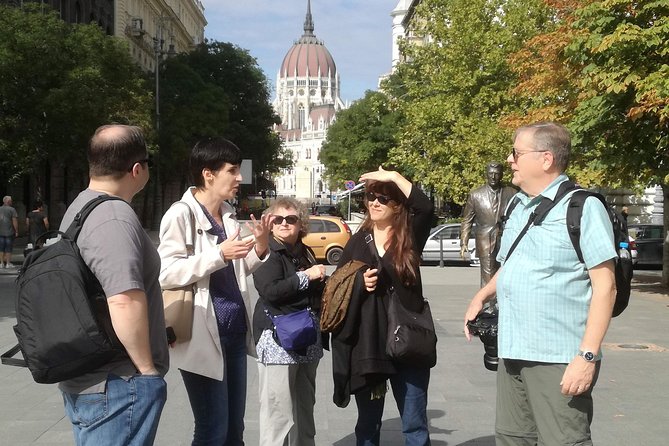
A short walk brings you to Freedom Square, and this part is one of the most “map-like” sections of the tour. Cold War history is treated like a set of physical clues you can identify with your eyes.
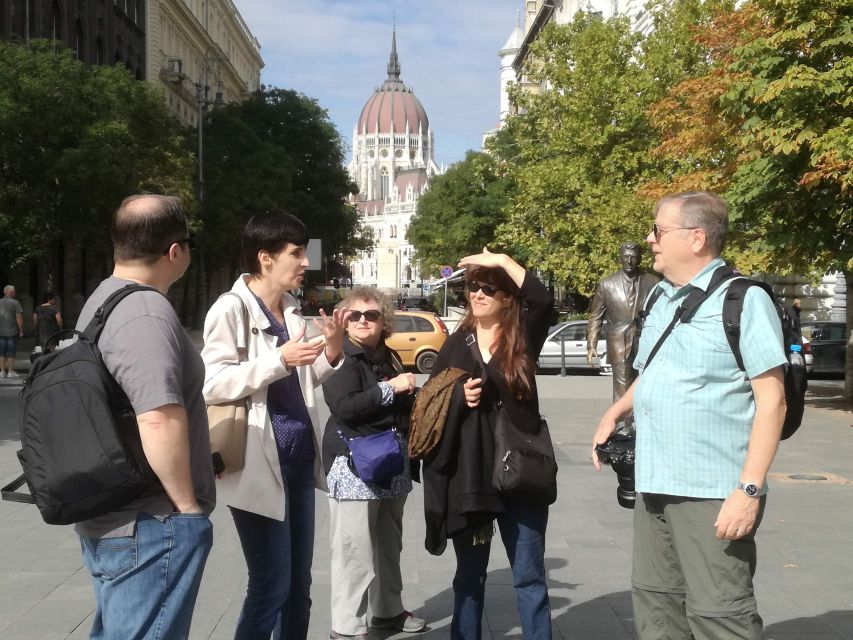
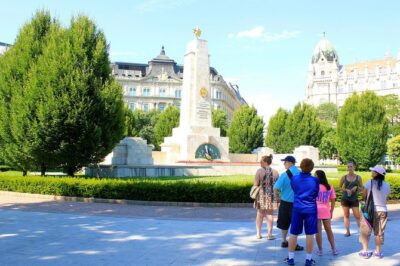
You’ll see four prominent stone structures that symbolize key forces of the era: the U.S. embassy, a monument to the Soviet army, a statue of President Ronald Reagan, and the entrance to a secret atomic shelter. Standing there, you get a clearer sense of how global tension was translated into local space.
Here’s the angle I think you’ll appreciate: the square is not just about superpowers. It’s about what Hungarians lived with while those powers watched each other. Your guide helps connect the monuments to the psychology of the period, where fear and propaganda both shaped choices.
If you like tours that teach you how to “read” a city, this is where the method shows. The landmarks are the chapter titles, but your guide supplies the missing sentences.
1970s housing estates: grey buildings with a real reason for hope
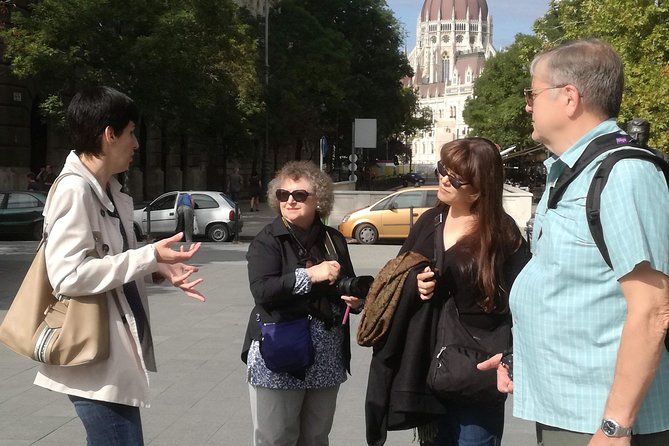
One of the most practical parts of the itinerary comes next. You’ll ride the metro to one of the 1970s housing estates at the edge of the city center.
Today, the apartment blocks can look drab and grey. But the tour’s point is to explain what they meant when they were new. At the time, young Hungarian families were overjoyed to be awarded apartments here, especially because elevators and other modern conveniences were not common in older Budapest buildings.
This stop is valuable because it breaks the habit of thinking Communism only equals repression. Yes, the system crushed freedom in major ways, but it also controlled housing, jobs, and the basics of daily life. People were often dealing with tradeoffs they could feel, not abstract policy debates.
So when you walk these estates, try to notice details with that lens: access, layout, and the promise of modernization. Even without a museum exhibit, you can see why the regime could present itself as a provider while also demanding obedience.
Puskás Stadium and Socialist Realist statues you can see clearly
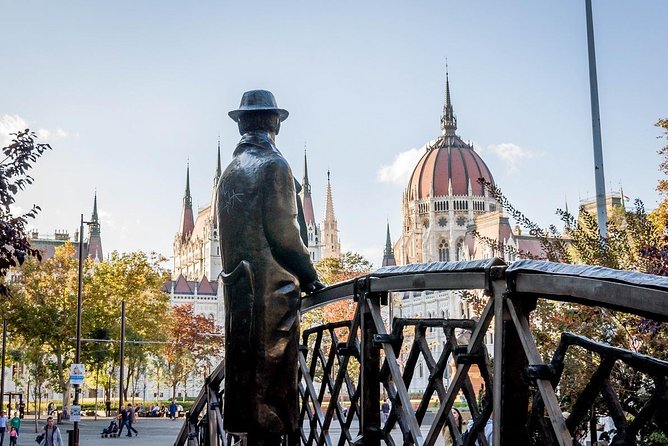
From housing blocks, you’ll head to the former People’s Stadium, now Puskás Soccer Stadium. This is one of the tour’s most visually striking transitions, because it’s where you can still spot typical Socialist Realist statues.
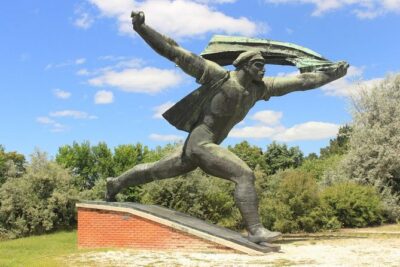
Socialist Realism was propaganda with muscles and faces. You’ll see heroic workers, soldiers, and intellectuals, pointing toward a bright future. The message is simple and loud: the state is guiding history, and the right kind of people are on the right path.
What makes this stop work is that it connects art style to political function. These statues were not made for subtlety. They were made to be understood, repeated, and absorbed in public space. When you see them in a real setting, with your guide explaining what the figures represent, the propaganda becomes legible instead of just decorative.
The tour keeps it grounded by relating this ideal of the future to what people had to obey in real life. The contrast between the promised future and the lived reality is the thread that runs through the entire itinerary.
Other Budapest walks at a similar pace
Dozsa György Street: trolley buses, May Day parades, and staged spectacle
You’ll take a short ride on one of Stalin’s trolley buses, then continue to Dozsa György Street, a broad boulevard used for May Day parades. This is a smart move in the itinerary because it adds movement and energy to the story.
May Day in Communist contexts was not only about labor. It was about visibility. Your guide will talk through how the boulevard became a stage for mass events, and how those events turned ideology into choreography.
Another bonus here is how your guide uses technology. You’ll use an iPad and older photos to compare how the city looked during the Stalin era versus today. It’s one of the best ways to make time travel feel practical instead of fuzzy. You can literally line up where the modern view changes and where history used to dominate the scene.
If you tend to learn best by matching images to locations, you’ll probably enjoy this segment a lot.
The House of Terror: crimes of communism in a former secret services HQ
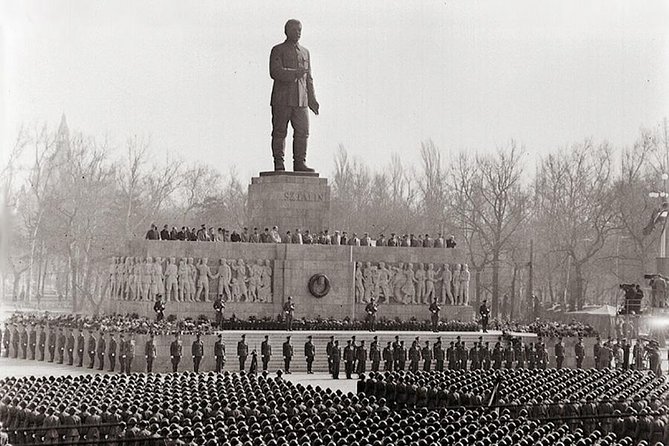
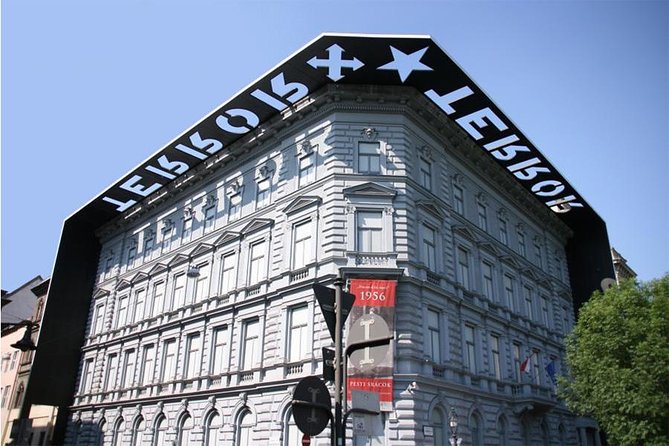
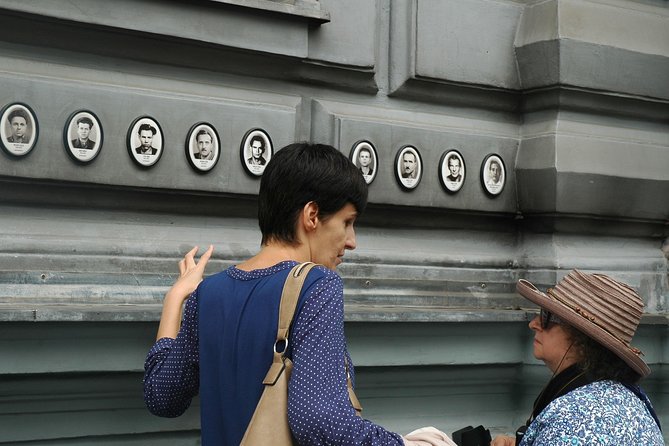
The tour’s final emotional punch lands at the House of Terror, a museum housed in the former headquarters of the secret services. In front of the building, you’ll also see a slab of the Berlin Wall, which adds another layer of Cold War symbolism to an already heavy setting.
This stop is focused on crimes of communism, especially during the Stalinist years. Since the museum is about repression and victimization, expect the tone to be serious. You do not come here for light entertainment.
What makes the stop matter in the broader tour is how it closes the loop. Earlier you’ve seen monuments, propaganda art, and housing benefits presented as part of a system. Here, the tour connects those public promises to the machinery that enforced them.
You’ll leave with a better sense of how totalitarian structures work. Even if you’ve studied the period on paper, this kind of location-based storytelling helps your brain store the details in the right place.
Price, value, and how to judge $123 for 3 hours
The tour costs $123 per person for a 3-hour guided experience with a historian guide. That price sits in the “serious guided tour” range, not the bargain range. So the question is value: are you paying for real expertise and a solid itinerary, or just a walk with a standard script?
This experience earns its value in a few specific ways. First, you are getting an academic-type guide, not a generic guide with quick facts. Second, you cover multiple high-impact locations in one run, from Bem József Square and Kossuth Square to Freedom Square and the House of Terror. Third, the format includes metro and trolley segments, so you’re not stuck dragging between far points just to meet the time length.
The one cost caveat is that tram and metro tickets are not included. Practically, that means you should plan for local transport payment so the tour flow stays easy. It’s a small add-on, but it matters.
On the guide side, I’d also consider how you learn. If you like conversation and context, you’ll likely appreciate what people describe as a relaxed pace and a guide who can adapt. If you know the period already, you may want to go in with a couple of specific questions, for example how daily life differed by decade, or how 1956 connects to later propaganda and housing promises.
Who should book this tour, and who should think twice
This tour is a strong fit if you want a structured way to understand Communist-era Budapest using real locations. It’s also ideal if you are the type who enjoys “reading” monuments, civic squares, and buildings as evidence, not just as scenery.
It’s also a good choice if you do not know much yet about Hungary between the end of World War II and the late 1980s. The tour is designed to provide a clear overview that you can build on afterward.
Think twice, or at least come prepared, if you already have solid background knowledge of Hungarian events in that period. This tour can feel like a core storyline rather than an advanced seminar. You can fix that easily by asking more pointed questions during the walk, and by paying extra attention when your guide uses older photos to compare eras.
Final call: should you book Communist Budapest Walking Tour?
I’d book it if you want an efficient, location-based guide to how Communism shaped Budapest in visible ways, from 1956 sites to Cold War symbols and the House of Terror. I like that it mixes ideology with daily life, including the 1970s housing estate stop where you see why modernization and comfort mattered to real families.
I would not treat it as your only source of information if you already consider yourself well versed in the era. In that case, go with questions and expect a guided overview, not a deep lecture on every internal political nuance.
If you want a tour that helps you connect the streets you walk with the history you came for, this is one of the best ways to do it in 3 hours.
More Tours in Budapest



More Tour Reviews in Budapest




More From the Socialist Years




Reviewed recently around Budapest
- Audio visual multi-sensory chefs journey dinner experience★ 5.0 · 3 reviews
- Tapolca Cave Lake and Tihany/ Balaton private tour from Budapest★ 4.5 · 3 reviews
- SzentEndre-SaintAndrew City Privately Shopping and Picturesque★ 4.5 · 3 reviews
- Sightseeing flight over Budapest★ 5.0 · 3 reviews
- Self Guided Tour In Budapest With 100 Captivating Audio Stories★ 5.0 · 3 reviews
- Private Danube Bend Visegrad and Szentendre Tour With Transport★ 5.0 · 3 reviews
Communist Era and Cold War Tours, compared.
 ★ 4.8Communist History Tour with House of Terror OptionFrom $58182 reviews
 ★ 5.0Communism in Hungary with a HistorianFrom $5970 reviews
 ★ 4.73-Hour Walking Tour About Communism (Small Group)From $5770 reviews
 ★ 4.5Budapest Hammer & Sickle Communist Times TourFrom $7968 reviews
 ★ 5.0Lives of Hungarians Under Communist and Capitalist systemFrom $459 reviews
 ★ 5.0Guided Tour with Admission in Memento ParkFrom $3048 reviews
 ★ 4.5Memento Park TicketFrom $1046 reviews
 ★ 5.0Memento Park Visit with Private Trabant TransferFrom $30544 reviews
Browse the lists this tour appears in